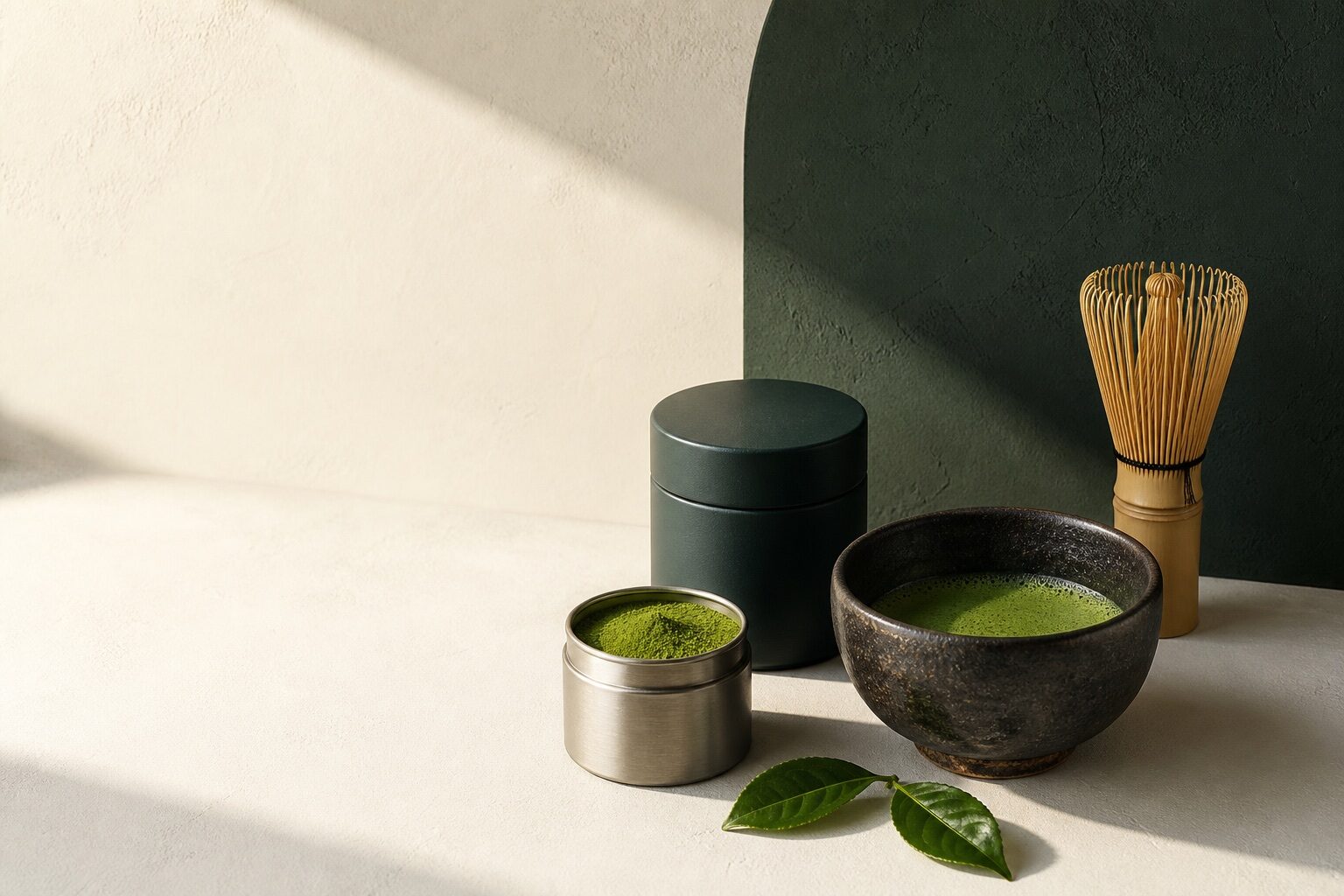
Private label matcha means a Japanese supplier packs matcha into consumer packaging carrying your brand. It is the fastest way to launch a retail product without building your own packing operation, but the minimums, timelines and responsibilities differ from buying bulk powder.
01 · How MOQ works
Minimums are set by packaging, not only by tea
With bulk matcha, the minimum is a weight. With private label, there are usually three minimums stacked on top of each other: the tea, the packaging components and the packing run.
- Tea: often modest once you are buying a standard grade.
- Packaging components: printed tins, pouches, cartons and labels are made by third-party suppliers with their own minimum print runs, which are frequently the real constraint.
- Packing run: filling lines are set up per product, so packers set a minimum number of units per run.
Ask the supplier to state the minimum in units per SKU per run, and what happens if you order two sizes or two grades. Splitting a small total volume across several SKUs is what pushes projects over budget.
02 · Formats
Choose the format before you ask for a price
The format determines who does the work and where. Common options:
| Format | Typical use | Notes |
|---|---|---|
| Printed tin (30–100 g) | Premium retail | Highest packaging cost; long print lead time |
| Plain tin + label | Small first runs | Cheaper components, label can be applied in Japan or at destination |
| Stand-up pouch with zip | Retail and café | Barrier films protect color; artwork printed or labeled |
| Stick packs / sachets | Foodservice, e-commerce | Requires suitable machinery; higher per-gram cost |
| Bulk bag for local packing | Brands with a packer at home | Lowest Japan-side complexity |
If your volumes are small or uncertain, packing at destination from bulk is often the better first year, and you can move packing to Japan once volumes justify it. See bulk matcha packaging options.
03 · Artwork and labeling
Who is responsible for artwork and labels
The buyer normally owns the artwork and, critically, the legal label content for the destination market: product name, net weight format, ingredient statement, best-before format, importer details, barcodes and any claims. Japanese suppliers will print what you approve; most will not check your market’s labeling rules. If you make an organic claim, the certification and logo rules of your market apply, not Japan’s alone; see organic matcha certification and equivalence.
- Dieline from the packaging supplier before design starts
- Proof approval in writing, including best-before placement
- Barcode ownership (your GS1 prefix, not the supplier’s)
- Nitrogen flushing or oxygen absorbers agreed for pouches
04 · Lead time
Realistic lead times
A first private label run typically takes longer than the tea itself: packaging components must be printed and delivered to the packer, artwork approved, and a packing slot booked. Repeat runs are faster once components are in stock. Plan the launch date backwards from packaging, not from milling.
Printed tins and custom pouches are usually the longest lead item. Ask for the packaging lead time separately from the tea lead time.
05 · What suppliers ask
Be ready for the supplier’s questions
Suppliers who take private label seriously will ask you a set of questions before quoting. Having the answers ready signals a real project.
- Format, size and units per SKU for the first run and the year
- Grade or target sensory profile, and whether the tea can change between lots
- Destination market and any documents required
- Who supplies the artwork and packaging components
- Launch date and whether samples of the finished pack are needed first
- Payment terms and who owns leftover components
06 · Working with an agent
Where a Japan-side coordinator helps
Private label projects fail on coordination more than on tea: a proof approved late, a tin delivered to the wrong factory, a label that does not meet the importer’s rules. Our private label and OEM coordination service manages the supplier, the packaging supplier and the packing schedule in Japan so that the buyer approves at a few clear checkpoints. Related: how matcha OEM manufacturing works.
07 · FAQ
Frequently asked questions
What is the smallest private label matcha order a Japanese supplier will accept?
It depends on the packaging more than the tea. Plain tins or pouches with an applied label can be run in small quantities; printed tins and custom pouches carry component print minimums that are usually the real floor. Ask for the minimum in units per SKU per run.
Who is responsible for the label content on private label matcha?
The brand owner. Suppliers print or apply what you approve, but the legal content for your market — net weight format, best-before format, importer details, ingredient statement, claims and barcodes — is your responsibility. Have your importer or a labeling specialist review the proof.
Can I start with bulk and move to private label in Japan later?
Yes, and it is a common path. Packing at destination from bulk keeps first-year minimums low; once volumes and designs are settled, moving packing to Japan reduces handling and gives you finished, packed-in-Japan goods.
Related services: Wholesale matcha from Japan · Private-label matcha (OEM) · Quality and documentation
Japan-side support
Planning a private label matcha line?
Send us the format, target volume and launch date. We check which suppliers and packers in Japan can meet it and return the terms in writing.
Send your requirements