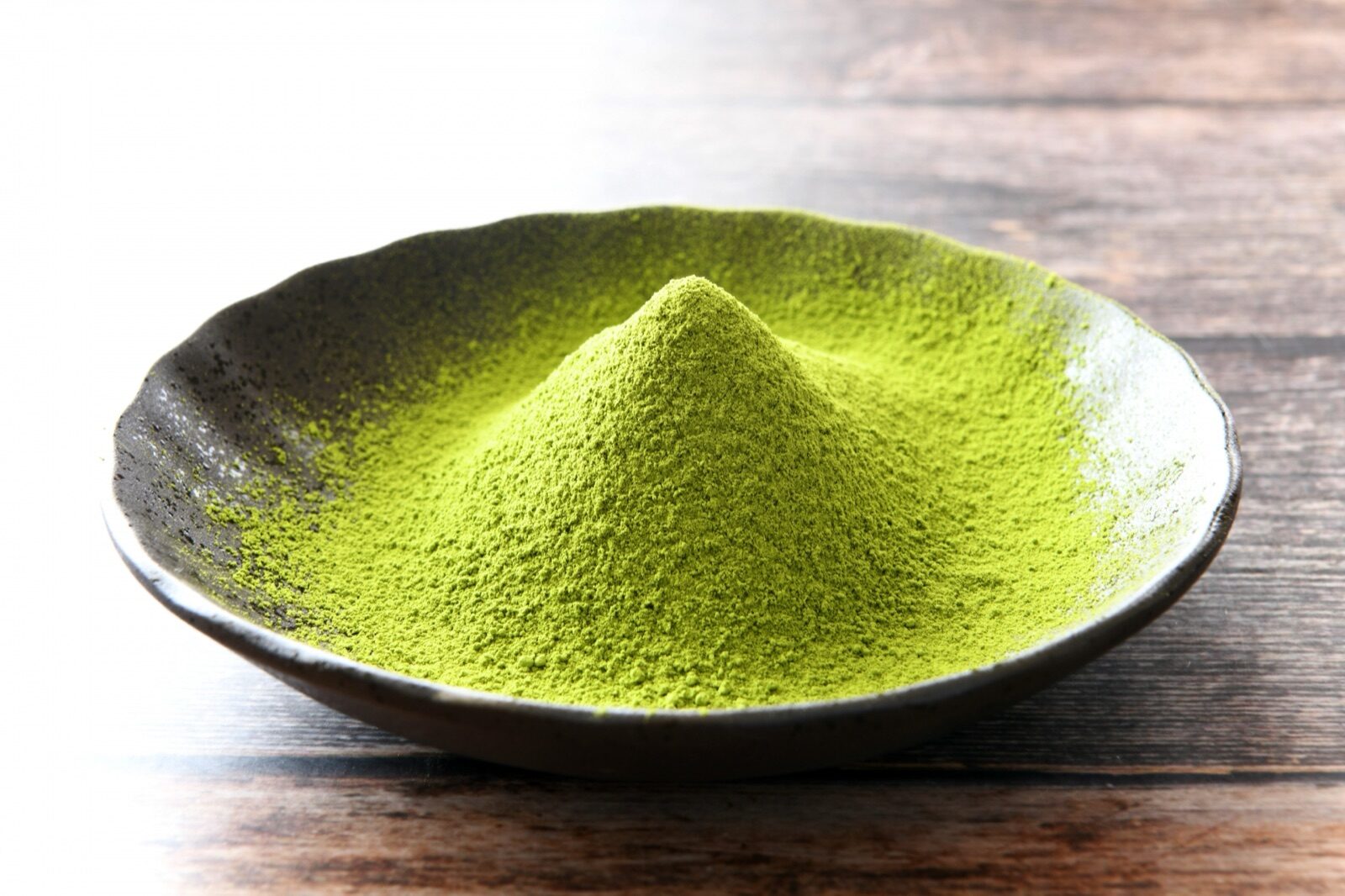
Matcha is tencha ground into powder. How it is ground shapes almost everything you notice about it: the silkiness on the tongue, how easily it disperses in water or milk, how long it stays suspended, how vivid the color looks and how much the supplier can produce per day. Buyers rarely specify particle size, and then wonder why two similar-looking powders behave differently in the same recipe.
01 · Methods
The main milling methods
- Stone mills. Slowly rotating granite mills produce a very fine, slightly irregular powder with minimal heat. Output per mill is small (on the order of tens of grams per hour), which is why stone-milled matcha is expensive and capacity-limited.
- Ball mills. Grinding media in a rotating chamber; faster and cheaper, capable of fine powders, sometimes with a slightly different particle shape and, if not controlled, more heat.
- Jet mills and other fine grinders. Air-jet or mechanical grinders can produce fine, uniform particles quickly. Used for some food and beverage grades.
None is “wrong”. Stone milling is prized for premium drinking matcha; other methods are legitimate for food and beverage applications, and some suppliers use them for premium grades too. What matters is that you know which method was used and what particle characteristics result.
Offer sheets from Japanese suppliers increasingly state the milling method per item — stone-milled, bead-milled, or a combination of mill types — and much of the matcha exported for lattes and food use is simply described as machine-milled. If the method is missing from a quote, ask: it explains both the price and the particle profile you will receive.
02 · Why size matters
What particle size changes
| Property | Finer powder tends to… | Coarser powder tends to… |
|---|---|---|
| Mouthfeel | Feel smooth, silky | Feel gritty or chalky |
| Dispersion in milk | Disperse and suspend longer | Settle faster, clump more |
| Color perception | Look brighter and more saturated | Look duller |
| Foaming when whisked | Foam finely | Foam coarsely |
| Oxidation and moisture uptake | Degrade faster (more surface area) | Hold slightly longer |
| Cost | Cost more per kg | Cost less |
The right target depends on the product. Premium drinking matcha values fineness; a bottled drink may care most about suspension and stability; a bakery may accept coarser powder because texture is lost in the dough. See matcha in RTD and bottled drinks and matcha for bakeries.
03 · Measuring
How particle size is measured and reported
Suppliers may report a median particle size (D50) in microns, a distribution (D10/D50/D90) from laser diffraction, or a sieve pass percentage. Ask which method was used; numbers from different methods are not directly comparable. If a supplier has no measurement, a reference sample plus a simple in-house test (dispersion in cold milk, sediment after a set time) is a practical substitute.
“D50 by laser diffraction, per lot” is a specification. “Very fine” is a hope.
04 · Trade-offs
Trade-offs to discuss with the supplier
- Finer is not free: fineness costs milling time and increases oxidation risk, so pair a fine target with appropriate packaging; see shelf life and bulk storage.
- Heat during milling can dull color and aroma; ask how the supplier controls it.
- Consistency between lots is a milling discipline as much as a leaf discipline; see lot-to-lot consistency.
05 · Questions
Questions to ask
- Which milling method is used for this grade?
- Do you measure particle size, and by which method?
- Can you provide particle data per lot?
- How do you control heat and moisture during milling?
- Is the same method used for every lot of this grade?
If you would like these questions answered by suppliers in Japan and matched to samples, see our quality and documentation service.
06 · FAQ
Frequently asked questions
How fine is matcha powder?
Well-milled matcha is a very fine powder, with median particle sizes commonly described in the low tens of microns or below depending on grade and method. Numbers depend on the measurement method, so ask suppliers how they measured.
Is ball-milled matcha lower quality?
Not inherently. Ball and jet milling are legitimate methods for many food and beverage grades and can produce fine, consistent powders. Premium drinking matcha is traditionally stone-milled. The point is to know the method and to specify the particle characteristics you need.
Why does my matcha clump in milk?
Coarser particles, moisture uptake and poor dispersion technique are the usual causes. Ask about particle size and packaging, keep powder dry, and sift or pre-mix before adding to milk.
Related services: Wholesale matcha from Japan · Private-label matcha (OEM) · Quality and documentation
Japan-side support
Need a particle-size target sourced?
Tell us the application and any measurements you have. We ask suppliers in Japan for milling method and particle data and return samples that fit.
Send your requirements