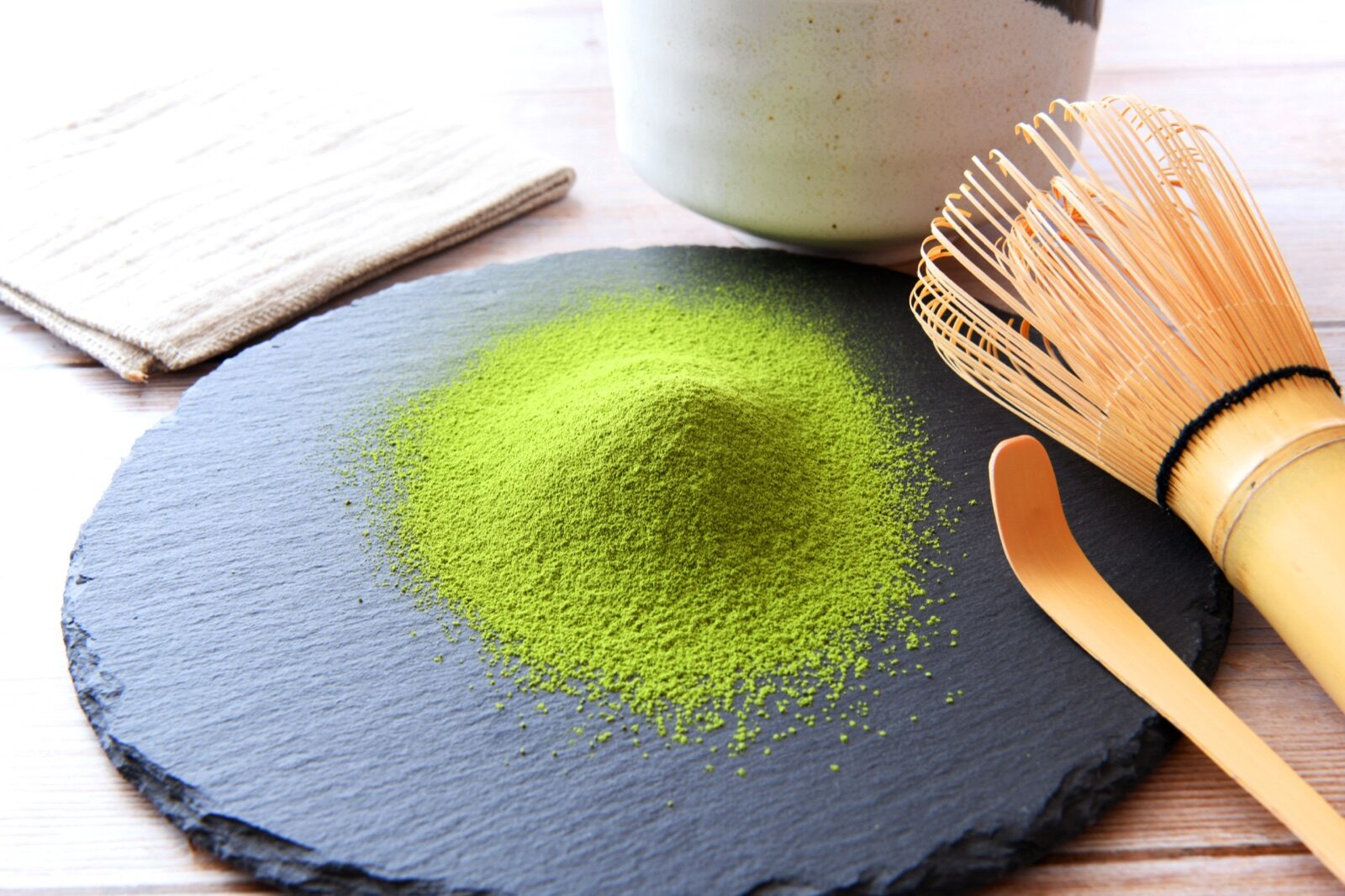
Ready-to-drink matcha — bottled lattes, cans, cold-brew style drinks and shots — is a category with real demand and real formulation challenges. Matcha is an insoluble powder; it does not dissolve, it suspends. And chlorophyll does not enjoy heat, light or acid. The grade you buy and the way you specify it are part of the formulation.
01 · Sedimentation
Suspension and sedimentation
Matcha particles settle over time. How fast depends on particle size and density, the viscosity of the drink and any stabilisers used. Finer, well-milled powders stay suspended longer and re-disperse more easily on shaking; coarser powders drop and cake. Ask suppliers for particle size data by a stated method and test candidates in your actual formulation over your actual shelf life; see particle size and milling.
- Test sediment height and re-dispersion after 1, 4 and 12 weeks
- Test with and without your stabiliser system
- Check for caking that does not shake back into suspension
02 · Color
Color stability under process and light
Heat treatment (pasteurisation, retort, UHT), acidic pH and light all shift green towards brown-yellow. Milk-based, near-neutral drinks in opaque packaging hold color best; clear bottles under retail lighting are the hardest case. Test finished packs under display conditions and record color over time; see how to specify matcha color. Some formulators start with a more vivid, bluish grade to leave headroom for process loss.
03 · Micro
Microbiological requirements
Matcha is an agricultural powder added to a low-acid beverage in many formulations, so its microbiological quality matters. Ask suppliers for their per-lot microbiological panel and detection limits, and whether they offer grades produced under controls suited to beverage manufacturing. Your process authority decides what is required for your product; the supplier’s COA is your evidence; see how to read a matcha COA.
04 · Grade
Which grade
RTD products usually use beverage grades chosen for color intensity, low astringency and consistent particle size, at manufacturing prices. Top drinking grades add cost without surviving processing intact. Some brands use a small share of a higher grade for aroma in premium chilled products with short shelf life.
| Requirement | Specification point |
|---|---|
| Suspension | Particle size distribution by stated method, per lot |
| Color | Reference sample and tolerance, in your process |
| Flavor | Bitterness descriptor and reference sample at target dose |
| Safety | Microbiological panel and limits per lot |
| Consistency | Lot approval against a retained reference; see lot-to-lot consistency |
| Supply | Annual volume and allocation terms; see supply agreement terms |
The best-tasting sample as whisked tea can be the worst after UHT. Run candidates through a pilot process before choosing.
05 · Supply
Supply and scale
Beverage volumes are meaningful, and Japanese mills and manufacturers who serve beverage customers can plan capacity and hold specification. Bring your annual forecast early in the harvest year; see the matcha supply calendar.
06 · Support
Sourcing for RTD
Our matcha for food manufacturers service sources candidate grades with particle and microbiological data from suppliers in Japan and coordinates samples for your stability trials.
07 · FAQ
Frequently asked questions
Why does matcha settle in bottled drinks?
Matcha is insoluble; particles suspend rather than dissolve and settle over time. Finer particle size, viscosity and stabiliser systems slow this; test sediment and re-dispersion over your shelf life.
Does UHT or retort destroy matcha color?
Heat treatment shifts green towards brown-yellow to some degree, more in acidic and clear-packed products. Start with a vivid grade, keep pH near neutral where possible and test finished packs under retail lighting.
What tests should the supplier provide for RTD grades?
Particle size by a stated method, a microbiological panel with detection limits and heavy-metal and residue results per lot, plus a retained reference for color and flavor.
Related services: Wholesale matcha from Japan · Private-label matcha (OEM) · Quality and documentation
Japan-side support
Formulating a matcha RTD?
Tell us the format, process and volume. We source candidate grades in Japan with particle and micro data and coordinate samples for your stability trials.
Send your requirements